A hallmark of British silverware
Posted by WATANABETAIGA

What is a hallmark?
British-made silver products always have a small stamp called a hallmark.
Regarding pocket watches, British watch silver cases also have hallmarks.
European silver products often have hallmarks, stamps that certify purity and other qualities, and these can be traced back to the Eastern Roman Empire in the 4th century.
The British hallmarking system was legalized during the reign of Edward I in the 14th century, and silver products were required to meet the standard of sterling silver (92.5% purity).
It seems this standard was set because 100% pure silver is too soft and difficult to work with.
The remaining 7.5% is copper or other metals, and in the world of Japanese antiques, it is customary to refer to anything that is sterling silver or higher in purity as "pure silver."
In 1327, Edward III granted permission for the establishment of the Worshipful Company of Goldsmiths, and the term "hallmark" seems to have originated from the practice of inspecting precious metals (gold, silver, platinum) and stamping them to certify their purity at the Company's headquarters (Goldsmiths' Hall) in London.
In the 16th century, financial difficulties led to the circulation of low-purity silver coins, so a more robust hallmarking system, equivalent to modern standards, was established in 1544.
Beyond the UK, countries like France, Germany, and Switzerland have also had hallmarking systems for a long time. However, British hallmarks are characterized by their high credibility because they classify not only purity but also the date and location of inspection, and even the manufacturer. They have also been strictly enforced compared to other countries, including penalties for violators.
How to read hallmarks
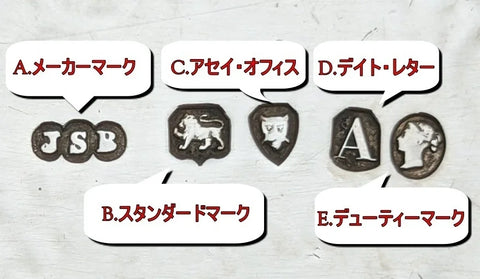
| A. Maker's Mark | This mark indicates the abbreviation of the manufacturer (workshop). |
| B. Standard Mark | This mark indicates purity. For sterling silver (92.5%), it is a left-facing lion mark called a lion passant. For Britannia silver* (95.84%), it is a goddess mark. *This was the standard for a period between approximately 1697 and 1720. |
| C. Assay Office | Assay offices were established in major cities in the UK, and this mark indicates which assay office certified the item. Major ones include London (lion's face), Birmingham (ship's anchor), and Sheffield (crown). |
| D. Date Letter | This indicates the year the item was assayed. Alphabets are used in various forms, including uppercase, lowercase, different fonts, and borders, and they vary even for the same year depending on the assay office. Before 1974, the renewal month reportedly differed by office. (May for London, June for Birmingham and Sheffield) |
| E. Duty Mark | This mark certifies the payment of duty. Silverware made between 1784 and 1889 was subject to tax, and the profile of the monarch at the time is stamped on it. However, there may be slight discrepancies with the actual reign of the monarch. |
The size of the hallmarks and the order of the stamps vary depending on the size of the silver product and the location where they are stamped.
Also, if parts are separate, such as the body and lid of a teapot, each part is stamped. If parts have been repaired or replaced along the way, different hallmarks may be stamped on different parts.
Even small parts like links on an Albert chain are individually stamped, but due to the small stamping area, only the standard mark might be present, or the maker's mark might only be on the largest component.
Silver-plated items also have marks, but the rules are not as strict as for sterling silver hallmarks, so deciphering them is more complex.
How to research hallmarks

Several books have been published that explain hallmarks.
Notably, "English Silver Hall-Marks" by Judith Banister is considered the bible for British antique dealers.
You can also research them on this website.
【Research Procedure】
- First, identify the assay office.
The date letter for each year varies by assay office. - Next, identify the alphabet of the date letter.
This is done by distinguishing between uppercase/lowercase, font, and borders.
If 1 and 2 can be identified, the manufacturing year can be determined.
If the assay office or date letter is difficult to distinguish due to wear, proceed to the following steps. - Check for the presence of a duty mark.
If there is a duty mark, it was made between 1784-1890.
If it is a male figure (George III/IV, William IV), it is 1784-1837.
If it is a female figure (Queen Victoria), it is 1838-1889. - Research the maker's mark.
You can find out the period in which the manufacturer was active. - Examine the shape of the lion passant.
Even the smallest silver part will have a lion passant.
The shape of the tail, forelegs, etc., varies slightly over time, so you can estimate the approximate era from this.
Silver is a soft metal, so hallmarks may be faint due to wear from years of polishing.
However, even with faint marks, it is enjoyable to research the age, origin, and manufacturer from subtle characteristics of the stamp.
Once you get the hang of it, it becomes easy to identify, so please take a look at your own silver items.